A Palliative Approach to Care in Oxford
April 14, 2026 - A Palliative Approach to Care in Oxford
[April 14, 2026] – Palliative care is often misunderstood as care provided only at the end of life. The word “palliative” itself can cause fear or panic, when really, this approach to care focuses on comfort, dignity and quality of life throughout a person’s health journey. Palliative care is not just provided at “the end”, and it is the mission of our Clinical Coach to reframe how palliative care is viewed and provided locally.
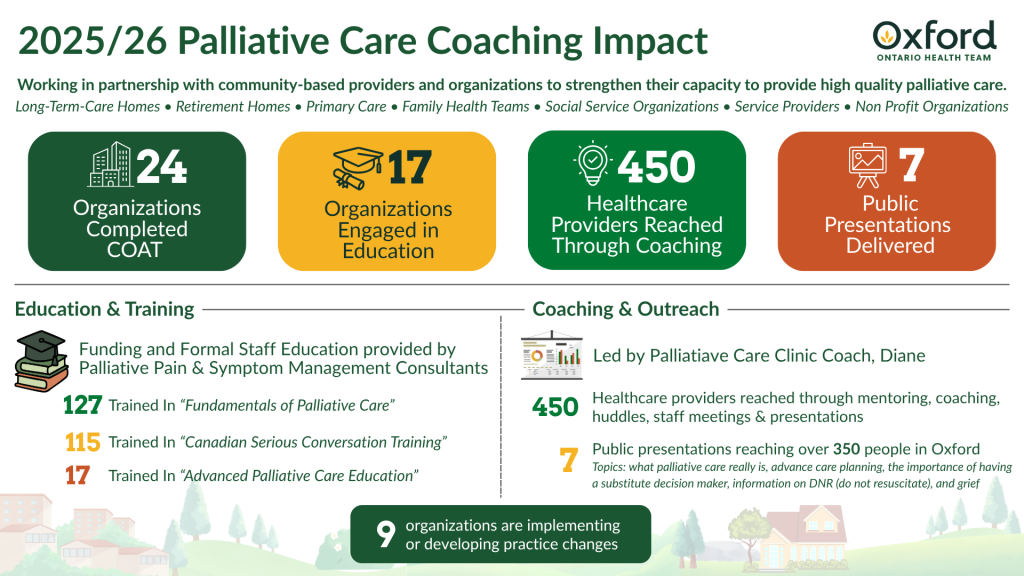
For the past two years, Diane Murray, Clinical Coach, Palliative Care with the Oxford Ontario Health Team (OHT), has been working with organizations across Oxford County to help bring a palliative approach into everyday healthcare practice.
“As the Clinical Coach for Oxford County, I have been supporting our community in weaving the philosophy of a palliative approach to care into everyday healthcare practice,” says Diane. “A palliative approach to care is not only about providing excellent care at end of life – it is about bringing dignity, comfort and truly person-centred care to the forefront at all stages of a serious illness.”
Through her role, Diane partners with organizations to support high-quality palliative care. This includes helping teams identify opportunities for improvement, connecting providers with education and resources, and supporting practical changes that help ensure care aligns with what matters most to the individuals and their families.
“By supporting healthcare providers to adopt a palliative approach to care, we are reinforcing that palliative care is truly person-centered, high quality care that should be delivered by everyone and is everyone’s responsibility,” Diane says.
This work has been ongoing across Oxford County. The following stories highlight how local organizations are putting this approach into practice and the difference it is making for clients, families and care teams.
Connecting Teams with Palliative Care Education
Palliative Pain & Symptom Management Consultants, St. Joseph’s Health Care London
One of the key ways Diane helps strengthen palliative care across Oxford County is by connecting organizations with education and expertise that can support their teams.
In her work with community partners, Diane identifies areas where providers may benefit from additional knowledge or training. She then works closely with the Palliative Pain & Symptom Management Consultants (PPSMC) from St. Joseph’s Health Care London, including consultants Hope McTaggart and Carina Jacob, to bring targeted education opportunities to organizations in Oxford.
“Palliative care opens doors that might otherwise remain closed,” says Hope. “It’s not just about the final days of life – it’s about supporting quality of life and helping people live as fully as possible, even while facing serious illness.”
Together, Diane and PPSMC have organized a range of learning opportunities for providers in Oxford County, including Fundamentals of Palliative Care and Serious Illness conversation Training for staff, Comprehensive Advanced Palliative Care Education for nurses, and in-service training for individual organizational needs. These sessions help build confidence among providers to recognize when someone may benefit from a palliative approach, and to have meaningful conversations with clients and families about goals of care.
Through this collaboration, education has reached over 250 staff and volunteers across a wide range of care settings in Oxford County.
“Clinical Coaches play such an important role in opening doors to education opportunities and bridging the gap between what the community needs and what we can offer. In busy settings like long-term care, education can easily fall to the back burner. Having that dedicated connection, along with funding support, makes a huge difference in being able to reach teams, spread awareness of a palliative approach to care, and diminish the scariness of the word.” – Hope, PPSMC
Supporting Earlier Conversations in Long-Term Care
Woodingford Lodge
At Woodingford Lodge (WL), a long-term care home serving over 220 residents across multiple sites in Oxford County, the team has long been committed to providing compassionate end-of-life care. Through their work with Diane, they began exploring how a palliative approach could start even earlier in a resident’s journey.
Diane and the WL leadership team completed a Community Organization Assessment Tool (COAT), which helps organizations identify strengths, gaps and opportunities to strengthen palliative care practices. One opportunity that emerged was the ability to identify signs of decline sooner and begin end-of-life planning conversations with residents and families earlier.
“A big component for us is changing how people think about palliative care,” says Erin McMahon, Director of Care at WL “It’s not something to be afraid of – it’s about providing the best possible care. By identifying decline earlier and supporting staff to have these conversations, we can help make those discussions feel less intimidating for residents and families.”
As part of this work, WL is introducing a new practice that empowers personal support workers (PSWs) to document early indicators of decline they observe in day-to-day care. When these indicators are flagged, registered staff complete a clinical assessment and can initiate conversations with families about goals of care and next steps. This approach helps ensure that changes in a resident’s health are recognized and formally documented sooner and that families have the opportunity to discuss wishes, priorities and care planning.
Education with the Palliative Pain and Symptom Management Consultants has also played a key role in strengthening this work. With support and funding through the Clinical Coach role, more than 30 WL staff have participated in Fundamentals of Palliative Care training, with additional nurses pursuing advanced education. Removing the cost barrier made it easier for staff to access training and build confidence in having important conversations with residents and families.
“Every long-term care home wants to continue improving how they support residents and families, but there isn’t always the time or resources to develop new processes,” says Erin. “Diane did so much of the groundwork for this, and that made it possible for us to move this work forward in a way we wouldn’t have otherwise.”
The WL team aims to share their early indicators of decline approach more broadly after implementation, with hopes of helping other long-term care homes explore similar ways to integrate a palliative approach into everyday care.
Strengthening Support for Community Members and Caregivers
VON Oxford
For many people living with serious illness, care happens at home and in the community. At VON Oxford, staff and volunteers support individuals and families through programs that help them remain independent while navigating their health needs.
Through VON’s work with Diane, many staff and volunteers have participated in palliative care education, including Fundamentals of Palliative Care and Serious Illness Conversation Training. “Having access to this training helps our team feel more confident in how to approach conversations with individuals and families who may be experiencing serious illness,” says Robin Kish, Manager of Home and Community Care at VON Oxford.
Beyond education, working with Diane also helped identify gaps in processes and resources locally, sparking new ideas to better support both clients and caregivers. One example is the implementation of an early identification tool (SPICT – “Supportive and Palliative Care Indicators Tool”) to recognize signs that a client may benefit from additional supports sooner. This allows teams to act proactively rather than reactively by identifying changing needs earlier. They can then connect individuals with services and supports like assisted living, day programs, hospice care, home help, and more.
These discussions also led to the development of new caregiver supports in Oxford County, including the Caregiver Ally Program, which offers additional resources and support for caregivers who may be navigating serious illness or grief, and a grief pamphlet outlining the different ways in which grief can affect us.
“Being able to connect with Diane and talk about what supports were available – and where there were gaps – helped us think about how we could expand services for caregivers in our community,” says Robin. “It’s been such an asset to have her supporting us.”
Extending a Palliative Approach to Developmental Services
Woodstock and District Developmental Services
For organizations supporting individuals with developmental disabilities, conversations about serious illness, declining health and end-of-life care can be complex, but remain important.
Woodstock and District Developmental Services (WDDS) supports more than 130 individuals across group homes and independent living programs in Oxford County. Through their partnership with Diane, the organization began exploring how a palliative approach to care could better support both the individuals they serve and the staff who care for them.
One of the ways WDDS is making progress is by arranging a series of 12 staff meetings facilitated by Diane to introduce the concept of a palliative approach to care. The goal is to create comfort with the topic and build confidence with staff.
Many WDDS staff, including leadership and members of the organization’s Health and Wellbeing Committee, are also participating in Fundamentals of Palliative Care training.
“Developmental services are sometimes overlooked in conversations about palliative care,” says Crystal White, Director of Operations at WDDS. “Working with Diane has helped us start thinking more intentionally about how we can be better prepared to have these conversations with our teams, people supported, and their families.”
WDDS is also working with Diane to adapt an early warning tool that helps staff recognize signs of decline and document changes in health. Because many individuals supported by WDDS may have difficulty communicating symptoms, frontline staff are often the first to notice subtle changes in behaviour, appetite, or overall wellbeing. The tool helps staff track those changes and advocate more effectively for the person they support when working with healthcare providers.
The organization is also beginning to explore how to better support staff and people supported through grief. Many WDDS staff have supported the same individuals for years or decades, creating close relationships that make loss especially difficult for teams and for others living in the home.
Through education and ongoing collaboration with Diane, WDDS is taking important steps toward ensuring a palliative approach becomes part of everyday care planning.
“A palliative approach to care is something we knew we needed, but we didn’t have the tools or resources. Having guidance from a Clinical Coach is going to be instrumental in developing processes and resources that help our staff, people supported, and their families feel more prepared in every step of the health journey.” – Crystal
Building a Community-Wide Approach to Palliative Care
A palliative approach to care has a place in all health and social services. By building knowledge, strengthening collaboration, and supporting practical changes in care, the work underway across Oxford County is helping create a more connected and compassionate system of care for individuals, families, and care teams alike.
“Palliative care belongs everywhere,” says Diane. “When health and social service providers across different organizations feel confident having conversations about serious illness and goals of care, it helps ensure that every person receives compassionate, person-centred care that reflects what matters most to them.”